There’s a strange kind of pride people take in not sleeping enough. Mention you got five hours last night and someone will nod like you’ve said something impressive. Mention you slept nine and you’ll get a joke about how nice that must be, as if rest were a luxury item rather than a biological requirement. This is the real obstacle standing between most people and better sleep. It’s not that we don’t know the tips — everyone alive has heard “put your phone away” and “keep a consistent schedule” a hundred times. It’s that, somewhere along the way, we decided sleep was optional. A nice-to-have. The first thing to sacrifice when the day runs long. It isn’t optional. And understanding why changes how you treat it.
What Actually Happens While You’re Out
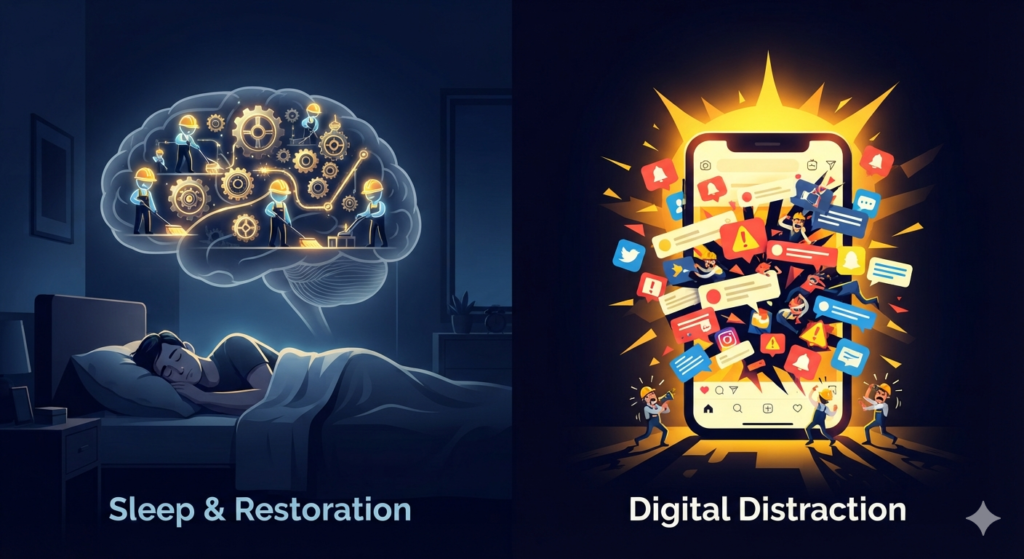
Sleep isn’t downtime. It’s closer to a night shift.
While you’re unconscious, your brain runs a cleaning cycle, flushing out metabolic waste that builds up during your waking hours — including proteins linked to long-term cognitive decline. This isn’t a loose metaphor; it’s a specific, named biological system. Researchers at the University of Rochester Medical Center identified it as the glymphatic system and found, in a study published in Science, that it becomes roughly ten times more active during sleep than during waking hours, clearing out amyloid-beta and other byproducts of neural activity that are implicated in Alzheimer’s disease. Your body is doing the same kind of maintenance elsewhere — repairing muscle tissue, regulating the hormones that control hunger and stress, and consolidating the day’s memories, deciding what gets filed away and what gets discarded. None of this happens properly if you cut the process short. Miss a night, and you feel it the next day — fog, irritability, a shorter fuse. Miss sleep chronically, and the effects stop being something you notice and start being something that quietly reshapes your health: elevated risk of heart disease, weakened immune response, worse blood sugar regulation, a measurable dip in the brain’s ability to regulate emotion. The occasional late night is not a crisis. A pattern of short sleep is a slow-moving one.
The Myth of “Making Up” Sleep
One of the most persistent and least true beliefs about sleep is that you can bank a debt and pay it off later — stay up late all week, sleep in on Saturday, call it even. You can’t, not really. A weekend of extra sleep can ease some of the acute fog, but it doesn’t reverse the accumulated cost of five short nights, and the pattern itself — sleeping badly on weekdays, oversleeping on weekends — creates its own problem with an actual clinical name: social jetlag. The term was coined in 2006 by chronobiologist Till Roenneberg, who defined it as the mismatch between your body’s biological clock and the schedule your work or school life imposes on you — the same kind of disorientation as flying across time zones, except you never left your bed. Your internal clock gets yanked in two directions every week, and the whiplash makes it harder to fall asleep well on Sunday night, which starts the cycle over again. The fix isn’t a big weekend correction. It’s consistency — the least exciting word in the entire conversation about sleep, and also the most effective one.
Your Body Doesn’t Care What Time It Is. It Cares What Time It Thinks It Is.
Here’s the part most sleep advice skips: your body doesn’t actually track the clock on your wall. It tracks light, temperature, and habit, and it builds a rhythm out of whatever signals you feed it, day after day. This is why waking up at the same time every morning — including weekends — does more for your sleep quality than almost anything else on the standard advice list. It’s why a dark, cool room matters more than an expensive mattress. It’s why the blue light from your phone at 11 p.m. genuinely does delay the release of melatonin, not because screens are evil, but because your brain is reading that light as a signal that it’s still daytime. None of this requires perfection. It requires repetition. A body that wakes and sleeps at roughly the same time every day, in a dark room, without a phone doing its best impression of the sun, will fall asleep faster and sleep more deeply than one left to negotiate a new bedtime every night.
The One-Sentence Version
If there’s a single idea worth taking from all of this, it’s this: sleep is not the reward you get after the important parts of your day are finished. It is one of the important parts of your day — arguably the one doing the most invisible work. You don’t have to overhaul your life to respect that. You just have to stop treating eight hours as negotiable, and start treating it as the baseline everything else is built on top of.g eight hours as negotiable, and start treating it as the baseline everything else is built on top of.
1 Comment